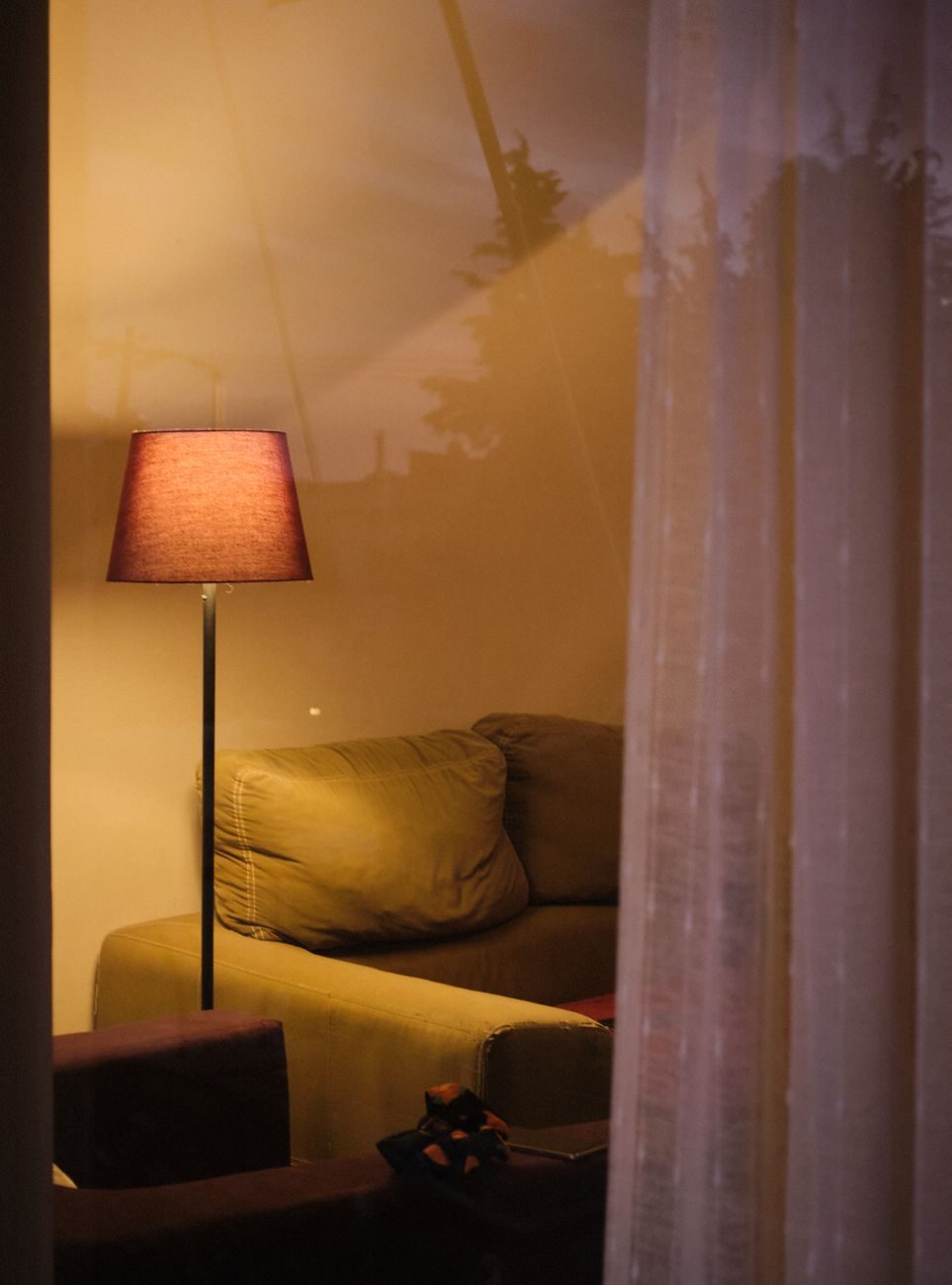
A well-lit living room at night has at least three things going on, and none of them are coming from the ceiling. There is ambient light — a primary pool somewhere between knee and shoulder height. There is task light — a focused beam where you actually sit and read. And there is accent light — a small, intentional source that gives the corner of the room a shape. Three lamps, three roles, three switches. That is the whole rule. Set the ambient at 300–500 lumens at shoulder height, the task at 600–800 lumens within 18 inches of where you sit, and the accent at 150–300 lumens in a corner the eye would otherwise skip — each warm (2700K), each dimmable, each on its own switch. A 150-square-foot rental can run the full system with three plug-in fixtures and a $700 budget, no electrician.
A single lamp, even a perfect one, only solves the easier problem. It gets you out of overhead-lit gymnasium territory. But a room with only one lamp on always feels half-lit — a stage with a single spotlight, missing the floor-fill and the rim. The three-light rule is the next move after the case for one good lamp: you stop replacing the ceiling fixture and start composing with light.
Why one lamp isn’t enough
The single-lamp argument was about replacing the overhead. The three-lamp argument is about building depth. They are different problems with related solutions, and most people skip the second one because the first one already feels like a win.
Here is the test: at night, with your one good lamp on, walk to the corner of the room furthest from the lamp. If that corner reads as “absent” — not dark in a deliberate way, just under-attended — the room is short one light. A well-lit room at night has falloff, but the falloff feels composed, not abandoned. You can produce that feeling with three lamps and a candle. You cannot produce it with one lamp, no matter how good.
The reason is geometry. A single light source produces a single fall-off curve. Two light sources produce an interaction — soft shadow on the side facing away from each. Three light sources, well-placed, produce a triangle of attention. The eye reads triangulated light as intentional; it reads single-source light as temporary.
This is not film-set theory imported into a living room. It is how lit interiors have worked since gas lamps. Look at any 1910 photograph of a sitting room and you will find at least three sources visible in the frame: a table lamp, a wall sconce, and a fire. The fire was the accent, the lamp was the task light, the sconce was the ambient. The three-light rule is older than electricity. We have just been overruling it for sixty years with single ceiling fixtures.
The three roles, defined
Each light in the system has one job. If a single fixture is trying to do two jobs at once, the rule isn’t working. Here is what each role is and where it sits.
Ambient — the room’s base layer
The ambient light is what the room defaults to when only one switch is on. Its job is to fill the room with enough light to walk through it safely, not enough light to read by. Brightness target: 300–500 lumens at the bulb. Position: floor or shoulder height, ideally aimed up or at a wall, never directly into the room.
The strongest ambient lamps are arc floor lamps with the shade tilted toward the ceiling, or a tall table lamp on a console behind a sofa with a fabric-shade-with-white-liner combination. The ceiling becomes a soft secondary reflector, the room reads as filled, no glare points exist.
Avoid: bare-bulb pendants used as ambient, downlights repurposed as ambient, “smart bulbs” set to 100% as ambient.
Task — where you actually sit and read
The task light is 600–800 lumens, placed within 18 inches of the activity. If your reading chair is by the window, the task lamp lives on the side table next to that chair. If your evening reading happens on the sofa, the task lamp is on the side table at the sofa’s end — not the middle, not behind it.
The task light is also the most controllable of the three. A three-way socket or a true dimmer is non-negotiable here. The task lamp at 100% during reading, dropped to 30–40% during conversation, off during a movie. Its job is to follow the activity in the room, not to broadcast.
Bulb: 2700K, CRI 95+ (your eyes will be working harder here than anywhere else in the room — color rendering matters most where attention concentrates).
Accent — the corner that earns the room
The accent is the smallest source and the one most people skip. Its job is to give the room a third point, breaking the symmetry of ambient + task and turning the visual field into a triangle. Brightness target: 150–300 lumens at the bulb — small. Position: a corner the eye would otherwise skip.
Good accents include a wall sconce above a sideboard, a picture light on a small framed work, a candle on a low table, a single low-output table lamp on a bookshelf at mid-height. The accent does not need to compete with the ambient or task; it needs to exist. The viewer reads it half-consciously as a sign that the room was finished.
The three layers, in one table:
| Layer | Brightness | Position | Bulb spec | Typical fixtures |
|---|---|---|---|---|
| Ambient | 300–500 lumens | Floor or shoulder height, aimed up | 2700K, 90+ CRI | Arc floor lamp, tall lamp on console |
| Task | 600–800 lumens | Within 18 in of activity | 2700K, 95+ CRI | Side-table lamp with three-way socket |
| Accent | 150–300 lumens | A corner the eye would skip | 2700K | Wall sconce, picture light, candle |
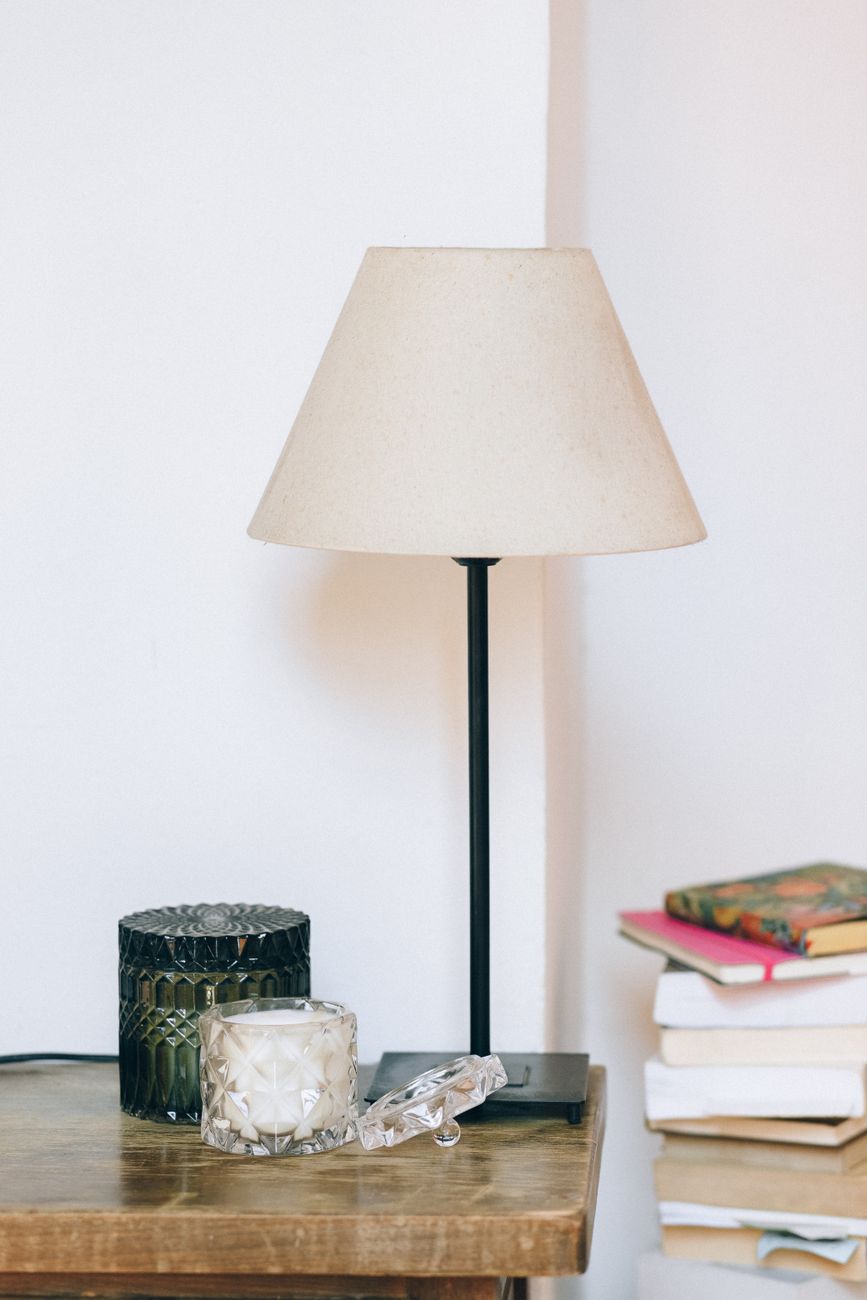
A worked example: a 150-square-foot rental living room
Theory falls apart in small rooms more often than in large ones, because there is less margin for placement error. Here is a real layout: a 150-square-foot living room (roughly 14m²) in a rental apartment, no overhead fixture you’d want to use, sofa on the long wall, armchair in one corner, a small sideboard on the short wall opposite the sofa. Three lamps, three roles, three plug-in solutions — no electrician, no landlord conversation.
The ambient lamp — behind the sofa
A 65-inch arc floor lamp sits behind one end of the sofa, with its shade angled to throw light at the ceiling above the seating area. The ceiling becomes the reflector; the room fills with a soft, indirect 350-lumen wash. Bulb: 2700K, 90+ CRI, dimmable. Cord runs down the back of the sofa to the wall outlet, invisible from any seated position in the room.
Why arc rather than a tall column lamp: in a small room, you cannot afford the footprint of a fixture between the wall and the sofa. The arc reaches over the furniture and places the light where you need it, without the base where you’d resent it.
The task lamp — on the side table by the chair
We covered this lamp in detail in the one-good-lamp piece — a brushed-brass table lamp with a frosted shade and an inline dimmer, paired with a 600-lumen, 2700K, 95+ CRI bulb. It sits on a small side table beside the armchair. When you sit down to read, this is the lamp you reach for first. When the room is empty, it stays off.
This is the single highest-value light in the system. If you only buy one good lamp, this is its role. The ambient and accent can be cheaper for longer.
The accent — a plug-in wall sconce or picture light
Mounted above the sideboard, plugged into the outlet behind it, cord run down the wall and tucked. A 200-lumen, 2700K bulb. This is the smallest, cheapest, and most optional lamp in the system — and the one that makes the room feel composed instead of merely functional.
A 12-inch picture light over a framed work does the same job at the same price, with the added value of giving the eye something specific to land on. Both are plug-in only — no rewiring, no landlord, no permanent change.
The result
Three switches. Each can be on or off independently. The room has four common evening modes: reading mode (all three on, task lamp at 100%), conversation mode (ambient on, accent on, task at 30%), movie mode (accent only, task off, ambient at 20%), and resting mode (accent only, very low). Four modes from three sources, none of them overhead, total fixture spend under $700.
The room photographs orange under camera-default white balance, the way warm rooms always do, and reads correct in person.
What about overhead lighting?
The short answer is: keep it for cleaning. The longer answer is that overhead lighting is Layer 4 — useful for tasks that need flood illumination (vacuuming, hosting a board game, finding a lost earring) but actively damaging to the look and feel of the room for any other purpose. A well-designed living room has a working overhead fixture; it just isn’t the room’s default setting.
If your overhead fixture is on a dimmer and can drop to 10–15% output, it can play a quiet supplemental role on overcast afternoons or when one of the three lamps is being repaired. But the moment the overhead goes above ~25%, the three-light system stops doing its job — the ambient/task/accent triangle gets flattened by the overhead’s omnidirectional fill, and the room reverts to looking like a place that is being inspected rather than being lived in.
The functional version of this rule: if there is a single switch by the door that turns on the overhead and only the overhead, replace its job. Three ways to demote the overhead, in order of effort:
- Rewire the switch to control an outlet your ambient lamp is plugged into. The wall switch now turns on the ambient lamp, the overhead becomes a manual pull-chain or a separate dimmer.
- Install a smart plug between the wall outlet and the ambient lamp. Pair it with the wall switch through HomeKit or a Lutron Caséta wall remote. Same effect, no electrician.
- Remove the overhead bulb entirely. Drastic but effective — if it has no bulb, you can’t accidentally turn it on. Worth doing for the first month while you adjust to the three-lamp routine.
The overhead should be the least convenient light in the room to turn on, not the most.
Dimming is what makes the rule work
A three-light system without independent dimming is a three-light system that’s wrong half the time. Each of the three lamps has different optimal output for different uses, and the way you use the system is by adjusting outputs, not by switching lamps on and off. Reading wants the task lamp at 100% and the ambient at 60%. Conversation wants the task at 30% and the ambient at 80%. Watching a film wants the accent only.
There are three working dimming approaches, in order of preference:
-
Mechanical inline dimmer on the cord — works with any standard incandescent or dimmable LED, no electrician, no app. The dimmer that comes with most quality lamps (IKEA TÄRNABY included) is this kind. Cheapest, most reliable, and the only one that does not produce a noticeable hum on cheap bulbs.
-
Lutron Caséta in-wall dimmer — $60 per dimmer, requires a real outlet on a switched circuit, but produces no hum across any LED brand we’ve tested. If your ambient lamp is on an outlet controlled by a wall switch, this is the upgrade that pays for itself the first evening.
-
Smart bulb (Hue Filament or Wiz) — works, but only worth it for the primary lamp where dim-to-warm behavior matters. For ambient and accent, a $5 mechanical dimmer beats a $35 smart bulb on every metric except convenience.
Avoid: cheap rotary wall dimmers paired with LED bulbs. The hum is real, it is constant, and it ruins the room.
Frequently asked questions
What is good lighting for a living room? Good living-room lighting after dark uses three or more independent sources, each at shoulder height or lower, with warm bulbs (2700K) and the ability to dim. No single light source should be doing all the work. The three-light rule — ambient, task, accent — is the working minimum.
Which type of light is best for a living room? For the room as a whole, layered light beats any single type. Within the layers: warm dim-to-warm bulbs (2200–2700K) at 90+ CRI for any lamp you sit near, dimmable on all three. Avoid 3000K+ “warm white” — it reads as cold once your eyes adjust. Skip overhead lights as primary sources entirely.
What is the new trend in lighting? The 2025–2026 shift is away from cool-white “modern minimalist” lighting and toward warm, layered, multi-source rooms — closer to early-20th-century interiors than to 2015 open-concept kitchens. Dim-to-warm LEDs and plug-in sconces are leading the change. We expect this to continue because it correlates with broader slow-living preferences and is also genuinely better for the eyes.
How can I add lighting without rewiring? Three options: plug-in wall sconces (mounted with the cord run down the wall to an outlet), arc floor lamps (no installation), and smart bulbs with a Lutron Caséta plug-in dimmer module. None require an electrician, all are reversible, and a complete three-light system using only plug-in sources is achievable for under $800 in a rental.
How many lamps does a low-ceiling living room need? A low ceiling (under 8 feet) makes overhead lights worse and lamp lights better — the three-light rule applies even more strongly. Keep ambient and accent at shoulder height or below to preserve the sense of ceiling height. Avoid arc floor lamps that reach above 6 feet, and skip ceiling-mounted pendants entirely.
Is “living room lighting” really three different layers? For an evening-use living room, yes. Three is the minimum that produces composed light rather than functional light. Four is sometimes better (adding a candle or a low fireplace glow as a fourth source); five usually becomes too much to manage. Three is the working answer.
Read next
- The case for one good lamp — the single-fixture argument this piece builds on.
- Our editorial approach — why we evaluate by years of use rather than launch-day specs.
- Affiliate disclosure — what we earn from what.
- More lighting pieces are in the works, including the rental-friendly layered setup in full detail and a longer piece on dim-to-warm behavior across bulb brands.