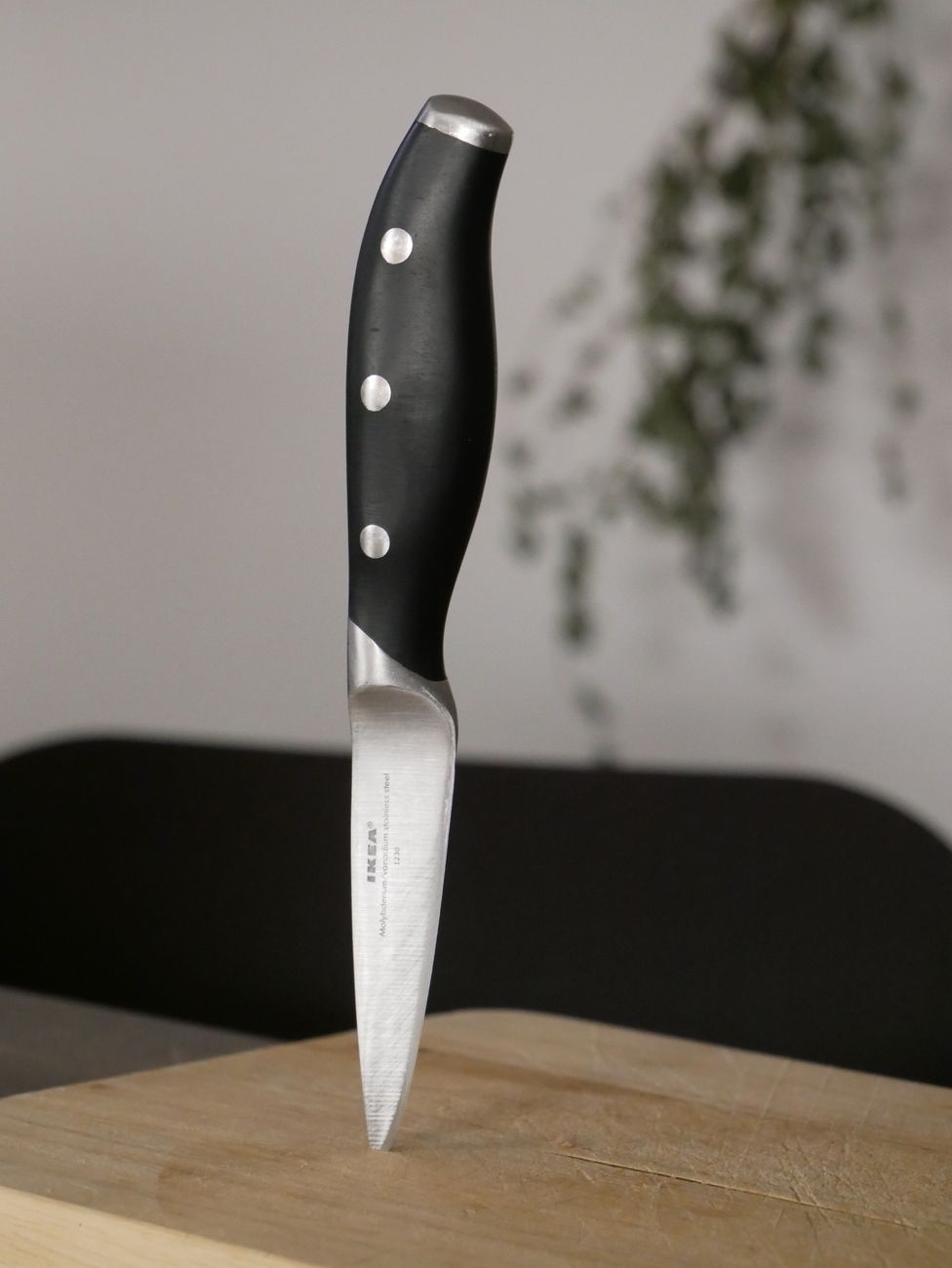
An 8-inch chef’s knife does 80 percent of a kitchen’s cutting work
A “good knife” here means a single 8-inch chef’s knife in a modern stainless or high-carbon stainless steel, hardened to 58 to 62 on the Rockwell scale, with a full tang and a handle you can grip for 30 minutes without your fingers going numb. Get those four things right and the same tool dices an onion, breaks down a chicken, chiffonades basil, slices a tomato without crushing it, and butchers a butternut squash. The average American kitchen holds 6 to 15 knives — usually a knife block from a wedding registry, plus a couple of steak knives and a serrated bread knife — and uses one of them for roughly 80 percent of the prep work. That one knife is the 8-inch chef’s. Everything else in the block is optional, occasional, or (in the case of the honing rod that came with it) purely decorative. Good chef’s knives run $40 to $260 across tiers, all three of them last 15 to 30 years with care, and the per-year cost of the middle tier is under $10 — less than a subscription to almost anything.
Why the knife block is a trick
The knife block is the cutlery version of the twelve-piece cookware set — the case for one good pan applied to a different drawer, and with the same conclusion. A standard block ships with an 8-inch chef, a 3.5-inch paring, a 5-inch utility, a 7-inch santoku, a serrated bread, kitchen shears, a honing rod, and six steak knives. Fifteen pieces, roughly $200 to $500 depending on brand, and three of them (paring, bread, shears) do genuine work the chef’s cannot. The other twelve are redundancy — smaller chef’s knives, in-between utility knives, and a santoku that overlaps 90 percent of what the chef’s does at a shorter length.
The industry sold blocks because a block sits on a counter and looks like completeness. A single 8-inch knife on a magnetic bar next to the stove looks like a design decision — which is what it is. A restaurant kitchen, with a real budget and no counter-real-estate constraint, still runs on one 8- or 10-inch chef’s knife per station, plus a paring knife for the two or three tasks the chef’s cannot handle. The home cook does not need more than that.
What the home cook does need — the piece that changes everything and that no knife block includes — is a sharpening system and the willingness to use it. A $40 Victorinox that gets sharpened every 4 to 8 weeks outperforms a $260 Shun that has been on a magnetic strip for two years unsharpened. The knife is the platform; the edge is the tool. This is the part most “best chef’s knife” guides skip entirely.
What does “good” actually mean in a knife?
Four properties separate a good chef’s knife from a bad one. Get these right and you can shop for a $40 Victorinox or a $260 Shun on the same terms.
Steel — modern stainless (X50CrMoV15, VG-10, AUS-8, or SG2/R2) beats everything else at the home-cook level. The old carbon-steel case (from serious cooking forums) is a preference argument, not a performance one — carbon holds an edge slightly better, rusts if left wet, and requires 5 minutes of extra care per week. High-quality modern stainless holds an edge nearly as well, does not rust, and is what every major professional brand now ships as their flagship line. If a knife markets itself as “carbon steel” as a virtue at the entry tier, it is compensating for something else being cheaper. Above $150, carbon is a legitimate choice; below, stainless is the right answer.
Rockwell hardness (HRC) — 58 to 62. This is the number that decides whether the knife takes and keeps an edge. Below 56, the steel is too soft (edge rolls, needs honing every use); above 62, the steel is too brittle for a home cook without a proper sharpening setup (edge chips). Japanese knives (Shun, Miyabi, Global) run 60-62; German knives (Wüsthof, Henckels) run 56-58 traditionally, though the Classic Ikon line has moved to 58; Made In and Misen run 58-60 in the hybrid Franco-Japanese tradition. The 58-60 range is the sweet spot for a household knife.
Full tang, riveted or bolstered handle. The tang is the part of the steel that extends into the handle. Full tang (steel visible from butt to tip of handle) is a proxy for how the knife was made — cheap knives usually skip it, quality knives never do. Riveted or bolstered handle means the handle is mechanically joined to the tang, not just glued; over 15 years of use, glued handles loosen and eventually fail.
Length — 8 inches, not 10, not 6. Chef’s knives come in 6, 8, 9.5, and 10 inches. The 8-inch is the point where a knife is long enough to rock through an onion in three motions but short enough to control on a home cutting board (usually 15-18 inches). A 10-inch chef’s knife is what restaurant line cooks use because their boards are 24-30 inches. A 6-inch chef’s is a specialized tool for tiny hands or small produce. If you can only own one, buy the 8-inch.
The four knife categories, in one table:
| Style / origin | Steel typical | Rockwell (HRC) | Edge angle | Weight (8-in) | Best for |
|---|---|---|---|---|---|
| German (Wüsthof, Henckels) | X50CrMoV15 | 56–58 | 18–20° | 8–10 oz | Heavier work, breaking down poultry, everyday rock-chopping |
| French (Sabatier, Made In) | X50CrMoV15 / X20 | 58–60 | 15–17° | 7–8 oz | All-around Franco-Japanese hybrid, lighter than German |
| Japanese Gyuto (Shun, Miyabi, Tojiro) | VG-10 / SG2 / R2 | 60–62 | 12–15° | 6–7 oz | Precision cuts, thin slices, drier meats |
| Japanese Santoku | VG-10 / SG2 | 60–62 | 12–15° | 6–7 oz | Push-cut style; shorter (usually 7 in); vegetables |
| Hybrid (Global) | CROMOVA 18 | 56–58 | 15° | 6 oz | Lightweight all-around; polarizing handle |
The table also explains why “which knife is best” is the wrong question. The right question is which cutting style your kitchen defaults to — heavier rock-chopping or lighter push-cutting — and matching a knife to that. Most American home cooks default to rock-chopping (learned from Julia Child and Food Network); most Japanese-trained cooks default to push-cutting (a straight up-and-down motion, better with a Gyuto or Santoku). A German or French chef’s knife is the safe first pick if you have never thought about it.
Three chef’s knives we’d actually live with
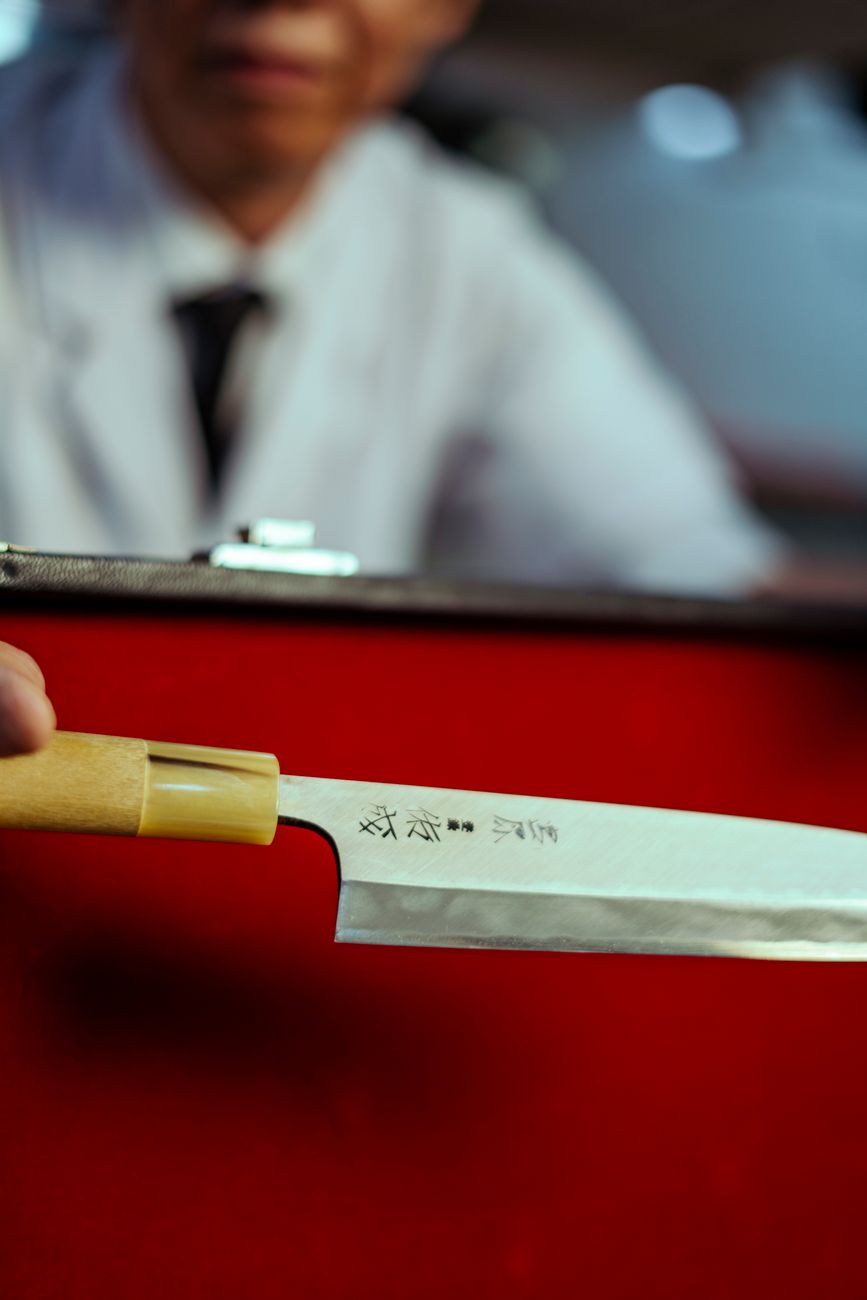
Three picks across three budgets. Each is an 8-inch chef’s knife (or Gyuto equivalent) with a full tang, a Rockwell hardness in the 58-62 sweet spot, and a track record of at least 5 years in editorial reviews. Affiliate state flagged honestly.
Entry — Victorinox Fibrox Pro 8-inch, around $40–50
The Fibrox Pro is the no-decision purchase for anyone who has ever wanted to “just get a knife that works.” It is Wirecutter’s top overall pick for eleven consecutive years, America’s Test Kitchen’s budget-tier winner across multiple retests, and the knife most professional culinary schools issue on day one. The steel is X50CrMoV15 (the same grade Wüsthof uses at four times the price), hardened to 55-58 HRC, with a stamped rather than forged blade — which is Victorinox’s specific engineering choice, not a cost compromise. Stamped blades are 20 percent lighter than forged, which is why professional cooks doing eight-hour shifts frequently prefer them.
The shortcomings are honest. The Fibrox handle is textured polymer — grippy, dishwasher-safe (not that you should), and dead ugly on a magnetic strip next to a Made In. The edge holds well enough at 55-58 HRC but wants sharpening every 4-6 weeks under home use. And the branding is unglamorous — nobody displays a Fibrox on a wall like a Japanese sushi bar. None of that matters when the knife performs.
Pair it with a $10 ceramic honing rod and a $25 whetstone (King 1000/6000 grit is the standard). Total kit under $80 for a knife that outperforms $200 knives that are not maintained.
Mid — Made In 8-inch chef’s knife, $119
This is the bracket where most single-household kitchens should land, and the knife that completes the Impact-network kitchen alongside the Always Pan and Perfect Pot. Made In’s chef’s knife is forged in Thiers, France (the historical cutlery capital) by Etain Cutlery, using X50CrMoV15 steel hardened to 58 HRC, with a full tang, riveted POM handle, and a factory edge sharpened at 15° — 3-5 degrees more acute than a German knife, which is the Franco-Japanese hybrid signature. It is the same steel and largely the same forging process as a $200-300 Sabatier at roughly half the price.
What you are buying: a 7.8-ounce blade with genuine forged construction (not stamped), a full-length bolster for finger protection during rock-cutting, a lifetime warranty against manufacturing defects, and a knife that looks correct on a magnetic strip for the next 20 years. The 58 HRC hardness sits precisely in the sweet spot — takes a fine edge, holds it through 3-6 weeks of home cooking, sharpens without chipping on a $25 whetstone.
We recommend this as the primary knife in any kitchen where the cook actually cooks 3+ times a week and cares about how the tools feel. It is also the knife that stops the “should I upgrade?” conversation for the next 15 years.
Heirloom — Shun Classic 8-inch, $200–260
The case for spending here is the same case as for an heirloom lamp or an heirloom pot: a $250 Shun Classic will be the same knife in twenty-five years, with the same edge profile, the same D-shaped pakkawood handle, the same 32-layer Damascus cladding around a VG-MAX core. Shun runs on the Japanese Gyuto tradition — a lighter, thinner, more acutely-angled knife than the German school — at a Rockwell of 60-61, which is high enough for excellent edge retention and just below the brittle threshold. The knife slices a tomato in one draw motion with the same effort a duller knife takes to crush it.
You are paying for: VG-MAX core steel (a Kai proprietary blend based on VG-10), the visible Damascus pattern along the flat of the blade (cosmetic, but the layers do reduce food-drag noticeably), a lifetime free sharpening program at Kai USA in Tualatin, Oregon (send the knife in with $8 shipping and it returns factory-sharp in 3-4 weeks), and a handle shape that fits the pinch grip better than any German knife will. The trade-off is that the acute 15° edge and 61 HRC hardness are less forgiving of cutting-board mistakes — no bones, no frozen food, no glass or ceramic boards.
The Classic 8-inch is the knife we recommend as the only knife for anyone willing to learn Japanese cutting technique (thin push-cut over a rock-chop). For traditional Western-style cooks, spend the same money on Wüsthof Classic Ikon at 8-inch instead — same tier, different tradition.
Five things one good knife does in a week
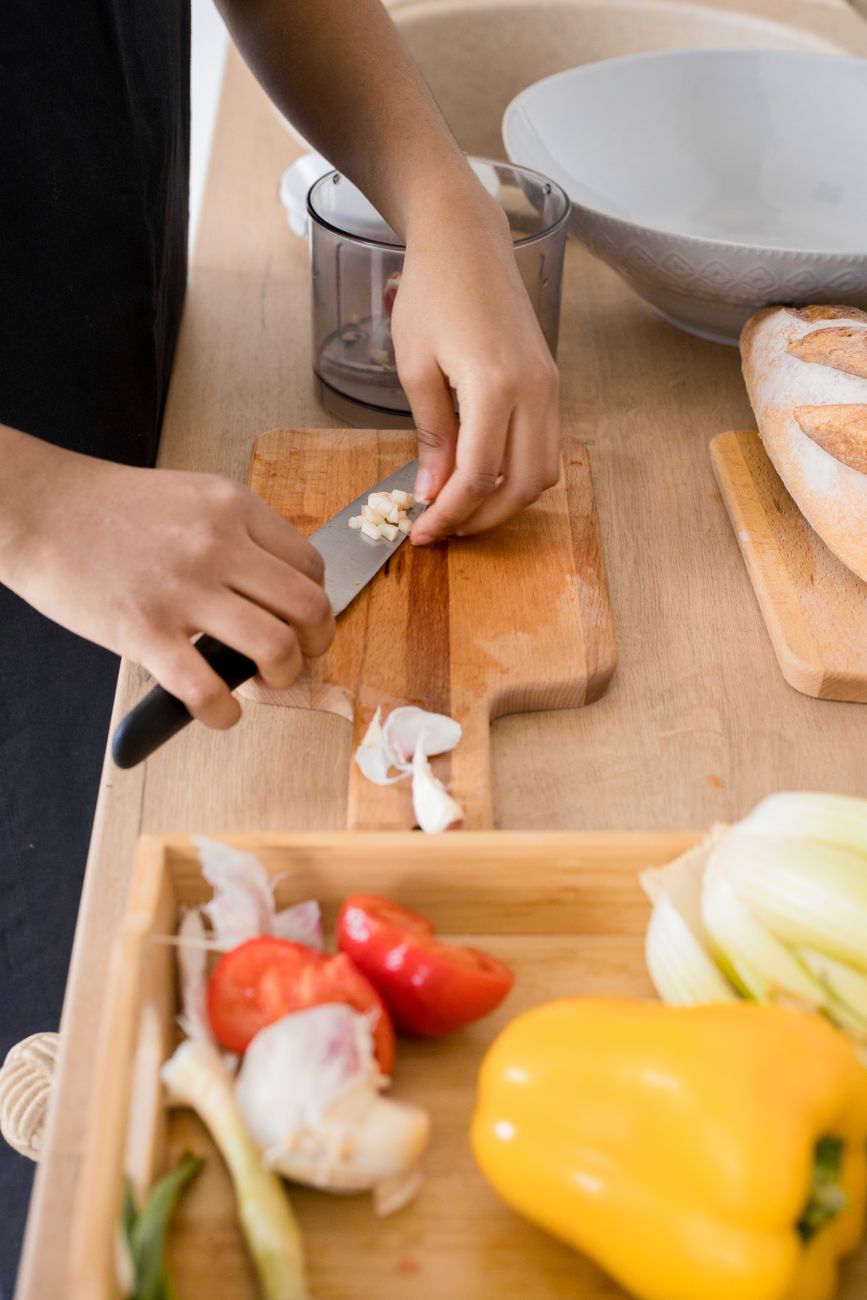
A knife earns the title “one good knife” only if it handles five distinct techniques across a typical week. The list below is the working repertoire — five moves that exercise the full range of an 8-inch chef’s. Run all five in the first month and the knife stops feeling like a compromise and starts feeling like the only knife the kitchen has ever needed.
- Rock-chop an onion. Tip anchored to the board, heel rising and falling in a pivot. Half-onion cut root-to-tip in vertical slices, then horizontal slices, then perpendicular slices to dice. Under 45 seconds when the knife is sharp. This is the technique the Fibrox and Made In were designed for.
- Push-cut garlic and shallots. Tip lifted, straight up-and-down motion. Smaller produce that would slip under a rock-chop. Best with a Japanese Gyuto because of the flatter belly, but a German knife with a good edge does it fine.
- Break down a chicken. Following joints, not cutting through bone. Chef’s knife handles the whole bird except splitting the breastbone (kitchen shears do that). Total time from whole chicken to eight pieces: about 6 minutes with practice.
- Slice a ripe tomato paper-thin. The knife-quality test. A dull blade crushes tomato skin and squeezes juice out; a sharp blade goes through the skin in one draw motion and leaves the slices standing upright. If a knife cannot pass this test, either the edge is dull or the knife is not right for the kitchen.
- Chiffonade basil. Stack, roll into a cigar, thin slices perpendicular. Fine motor precision test. Best on a Japanese Gyuto (thinner blade) but adequate on any 58+ HRC knife with a maintained edge.
Two rules of care that apply across all three tiers. First: hand-wash immediately after use, dry within 60 seconds. The dishwasher destroys edges (banging around against other utensils) and darkens handles (repeated wet-dry cycles). Second: sharpen every 4 to 8 weeks under home use — either at home on a whetstone, or ship it to the manufacturer, or drop it at a knife shop. Between sharpenings, hone before each session with a ceramic rod (steel rods are for old-school carbon knives). A well-maintained $40 knife outperforms a neglected $250 knife 100 percent of the time.
Living with one knife
A kitchen that runs on one knife, one pan, and one pot — the three-piece kitchen — is a kitchen that has answered the “what actually gets used” question at every drawer. The knife block leaves, slowly, over the first year. The magnetic strip goes up on the wall next to the stove; three or four knives (the chef’s, a paring, a serrated bread) live on the strip; the ninth santoku from the block gets donated or sold. The drawer of duplicate paring knives clears out. The steak knives, if you own them, go into a separate drawer because they are a specialized dinner-table tool that has no business being in the prep block.
Two things change once the knife rack is intentional rather than accumulated:
- Sharpening becomes a habit. Three knives on a strip is a small enough number that the sharpen-every-6-weeks cadence becomes visible. Fifteen knives in a block hide the fact that thirteen are dull and the one you use is the one you occasionally hone.
- The paring knife gets used more. A $10-20 paring knife is the one legitimate second knife (peeling, coring, deveining shrimp). It gets skipped in a 15-knife kitchen because nobody can find it; it gets used weekly in a 3-knife kitchen because it is visible.
- The bread knife earns its place or leaves. A serrated bread knife is the third legitimate knife, but only if you bake or buy artisan loaves. If bread comes pre-sliced from the supermarket, skip it — the chef’s does the rare loaf-slicing you actually need.
If you have read the case for one good pan and the case for one good pot, the three-piece kitchen is now complete: one skillet, one Dutch oven, one 8-inch chef’s knife. That is the actual foundation of home cooking. Everything else — the food processor, the mandoline, the extra saucepan — is a specialized tool answering a specialized question. Most kitchens do not have three specialized questions per week.
Frequently asked questions
What are the top 5 best knives? The consensus across Wirecutter, Serious Eats, America’s Test Kitchen, and Chef’s Choice in 2026 is: (1) Victorinox Fibrox Pro 8-inch as the budget pick; (2) Made In 8-inch chef’s as the mid-tier hybrid pick; (3) Wüsthof Classic 8-inch as the German heirloom pick; (4) Shun Classic 8-inch as the Japanese heirloom pick; (5) Global G-2 8-inch as the lightweight all-around pick. Note that all five are chef’s knives — the reviewer consensus is that the top knife in the kitchen is always a chef’s, not any specialized shape.
What is the #1 knife brand? By unit volume for home use, Victorinox is #1 globally — the Swiss army knife company sells more chef’s knives than any other manufacturer, driven by the Fibrox Pro’s near-universal recommendation. By editorial-review frequency in the premium tier, Wüsthof (Germany) is #1 in the West and Shun/Kai (Japan) is #1 in the Japanese school. Made In has grown fastest in the direct-to-consumer segment since 2020. “Best brand” depends on tier and tradition; “most-used brand” is Victorinox by a wide margin.
Why don’t chefs use Cutco? Cutco is sold through in-home direct-sales demonstrations and priced 3-5x above what its steel quality justifies. Its “double-D” serrated edge cuts poorly on tomatoes and paper (the two demo tricks), lasts about 2-3 years before the serrations round off, and cannot be sharpened at home the way a normal chef’s knife can. Professional chefs skip Cutco because it fails the basic test of taking and holding a straight edge — which is the only test that matters. The lifetime resharpening service is real, but you ship the knife off for 2-3 weeks each time.
What knife does Gordon Ramsay use? Ramsay’s restaurant kitchens run on Wüsthof Classic 8-inch chef’s knives (Germany, 58 HRC) — visible in every episode of Kitchen Nightmares in the sous chef’s roll. In his own home kitchen and on Masterclass, he uses a Henckels Zwilling Pro 8-inch and occasionally a Global G-2. The Ramsay-branded knives sold by ICON are made by an OEM manufacturer in Portugal to his specifications — mid-tier construction at heirloom pricing, similar quality to Made In at higher cost. Professional-kitchen brand is Wüsthof; home-kitchen brand is Henckels or Global; branded-line pricing is Ramsay.
Do I really need only one knife? For 80 percent of home prep, yes — one 8-inch chef’s knife plus a properly maintained edge covers rocking, push-cutting, dicing, mincing, slicing, and butchering short of bone. Two additional knives earn their place if the cooking calls for them: a 3-4-inch paring knife (peeling, coring, small trims) and a serrated bread knife (crusty loaves, tomatoes if the chef’s is dull). A three-knife kitchen handles 99 percent of home cooking. Anything past three is a specialized answer to a question you may not actually have.
How often should a chef’s knife be sharpened? Every 4 to 8 weeks under typical home use (3-5 meals per week from raw ingredients). Signs the knife is due: it slides off a tomato skin instead of cutting through, it crushes rather than slices onions, or it takes visibly more force to dice than it did last month. Between sharpenings, hone with a ceramic rod before each session — honing straightens the edge without removing metal; sharpening removes metal to create a new edge. Two different actions with two different frequencies. A well-maintained knife loses only a millimeter or two of blade width over 20 years.
Read next
- The case for one good pan — the first piece of the three-piece kitchen.
- The case for one good pot — the second piece.
- Non-toxic cookware: what the labels actually mean — the chemistry side of the same kitchen.
- Affiliate and editorial disclosure — what we earn from what.